

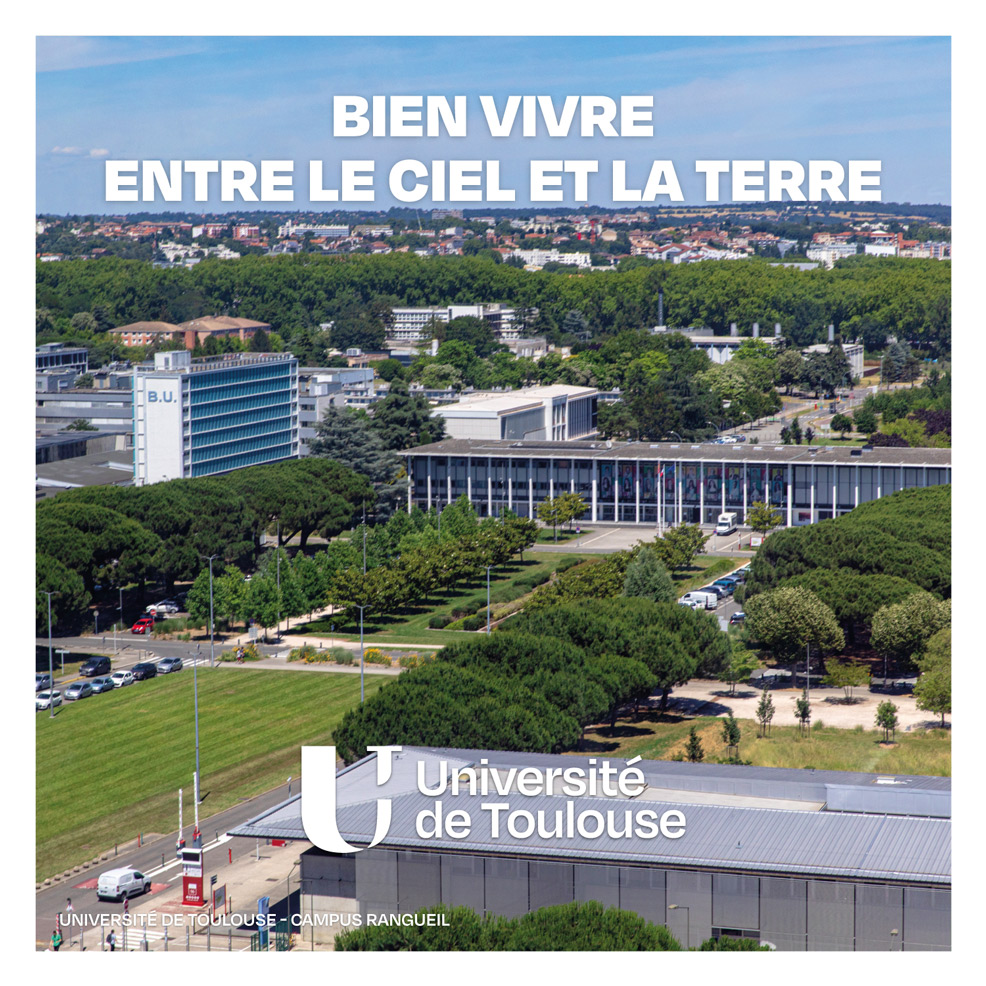
 Living well between sky and earth
Our shared ambition is to build a leading, world-class multidisciplinary university dedicated to research and education, recognized at both national and international levels, with a strong common identity and brand, enriched by the diversity of its constituent entities, and guided by the principles of respect, trust, and subsidiarity.Through complementarities and synergies, the University of Toulouse seeks to address three major societal challenges:
- well-being and healthy living
- aerospace and aeronautics
- agriculture and agri-food sectors.
- Learn more
-
With its strong research capacity across the natural sciences, engineering, and the humanities and social sciences, the Toulouse campus brings together higher education institutions, national research organizations, healthcare facilities, the CROUS, and the CREPS, all united around a shared vision: the University of Toulouse.
This project is part of jointly defined strategic priorities and a roadmap that includes a transition plan to assume responsibility for the inter-university missions and objectives currently carried out by the Toulouse University Community (ComUE).
Within this framework, the University is committed to addressing major societal challenges, in particular through its scientific contributions to well-being and healthy living, the development of the space and aeronautics sectors, and the transition toward more sustainable agricultural and agri-food systems.
Through an Experimental Public Institution (EPE), structured around the University of Toulouse (formerly Toulouse III–Paul Sabatier University) and its constituent institution, the Purpan School of Engineering, the academic strengths of Toulouse and its surrounding region are brought together. The two institutions share complementary training and research themes, a common commitment to sustainable development, and shared values of openness and inclusiveness.
This EPE will provide the conditions for the Occitanie Ouest area to establish a major, world-class multidisciplinary university dedicated to research and education, recognized at both national and international levels. It is characterized by a shared identity and brand, enriched by the diversity of its constituent entities, and guided by the principles of respect, trust, and subsidiarity.
The creation of the Université de Toulouse (EPE) on January 1, 2025, has laid a solid foundation and paved the way for the emergence of a leading and attractive university by 2028. It will foster synergies and interdisciplinary collaboration within a new institutional framework.
This enhanced visibility, both nationally and internationally, will have tangible and rapid effects, enabling, for example, the securing of substantial funding to support large-scale projects. The institution, which will coordinate campus-wide policy and related matters, will gradually replace the ComUE.
Strategic Axes
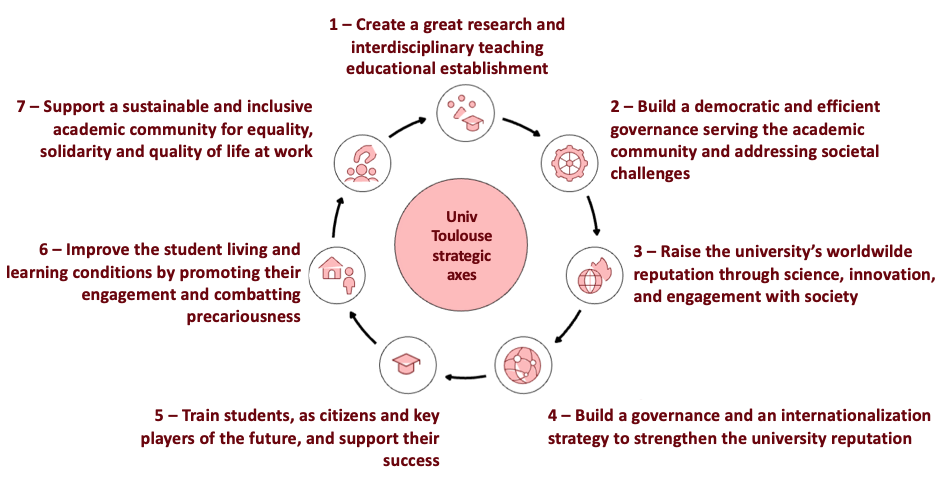
The University of Toulouse is structured around seven strategic priorities, which form the cornerstone of its development and evolution.
- Transcription
-
- 1 - Create a great research and interdisciplinary teaching educational establishment
- 2 - Build a democratic and efficient governance serving the academic community and addressing societal challenges
- 3 - Raise the university's worldwide reputation through science, innovation and engagement with society
- 4 - Build a governance and an internationalization strategy to strengthen the university reputation
- 5 - Train students, as citizens and key players of the future, and support their success
- 6 - Improve the student living and learning conditions by promoting their engagement and combatting precariousness
- 7 - Support a sustainable and inclusive academic community for equality, solidarity and quality of life at work
Committed Associates and Partners
Established with the support of the Occitanie Region and Toulouse Métropole, the EPE brings together thirteen higher education partners, seven national research organizations, two healthcare institutions, and additional organizations (see in French).